Module 2 - Systems Thinking
Module Overview
Let's Get Thinking!
Most of us rarely think about how we think. This is a process called metacognition — thinking about thinking — and one that is important for a game designer. You need to be able to think about how players think and about your own thought processes and to be able to tell the difference between the two. As a game designer, you must be able to understand the habits and limitations related to how people see and think about the world.
This is something I have seen so many times in the world of creation and more specifically when creating applications that others use. I am an artist and I am an engineer. I also work with artists and I work with engineers. With this cross-over viewpoint I often witness cognitive bias at work ALL THE TIME. This isn't necessarily the same cognitive bias that we talk about in diversity talks or awareness trainings -- Though its really the same thing at its core -- but what I am referring to is our cognitive bias that something we make makes sense to us so it should make sense to others. This could be a user interface for an app, a written set of instructions for someone else to follow, or it could be a game. (Yes, I recognize the irony in me making this statement while writing instructions for you all to follow :)
When we make something we poor our experiences into the making. We come to the creation process with our past fully known to us and our experience. We journey through the creation process knowing each and every turn we have made along the way. We know what we are making, and we know why we made it the way we did. Our folly is assuming that we know absolutely anything about what other people will understand about what we have made when they don't share our history and weren't with us through the journey of creation. People who view, use, play, listen, fix or otherwise interact with the things we create will not have grace for how hard we try or how much we care. This is especially true if we are not present as they interact.
Take a look at this image and see how many different perspectives can be determined be different people inside the creation process of a tree swing. It is meant to be funny (And it is), but it is also very true.
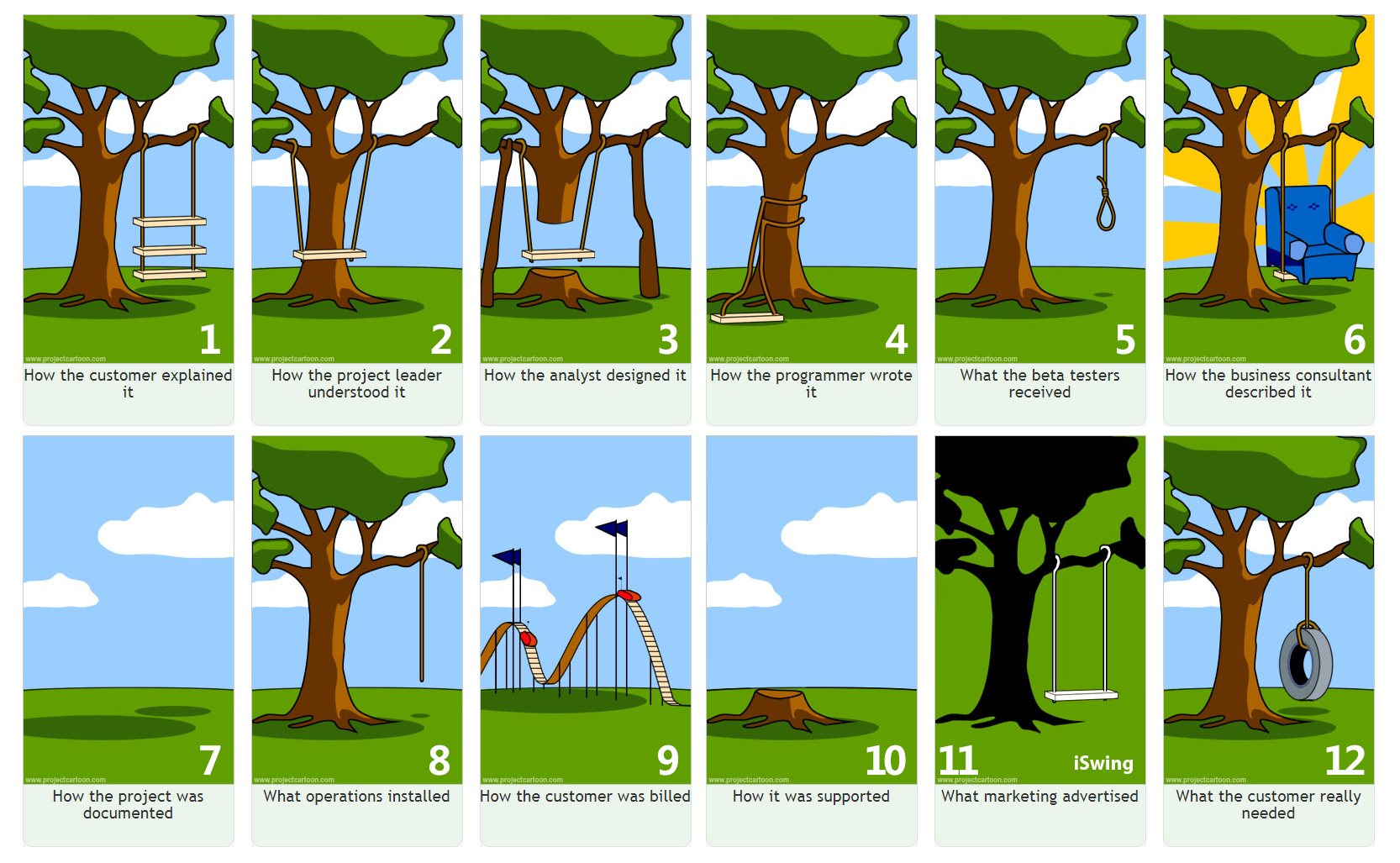 Click on the image to view full screen
As game designers it is our impossible task to not only try and understand our own biases and pre-conceived notions, but to try and understand and predict our players biases and pre-conceived notions. Sounds lovely right? How could we possibly assume we could be successful at this given the impossibility of the ask. The answer can be boiled down to 3 points in my opinion:
Click on the image to view full screen
As game designers it is our impossible task to not only try and understand our own biases and pre-conceived notions, but to try and understand and predict our players biases and pre-conceived notions. Sounds lovely right? How could we possibly assume we could be successful at this given the impossibility of the ask. The answer can be boiled down to 3 points in my opinion:
- We have evidence of it being possible because there are tons of games that are successful and they were made by people like you and me. Just as flawed. :)
- We have tools that have been developed throughout human history that we can employ to help us along the way
- This one is a nasty little secret We can actually affect and change our players biases to develop new ones or at least move them in the direction we want them to.
This lesson at its highest level is how to approach how we think about the world through exercises in expanding how we think about games and its elements. Most importantly it is about how we think about our players and how we can approach the design of our games with the right thinking that is effective and efficient.
Let's get started by going high level with systems as a wholeSystems
As we begin to look at systems we have to first decide how we are going to think about them. First, what is a system?
Dictionary Definition: "a set of things working together as parts of a mechanism or an interconnecting network."
Not a bad definition. The main point here is that systems involve different things that combine in different ways that brings about different effects.
Furthermore systems themselves can combine in different ways with other systems to form larger systems and as the environment and conditions change so do the effects systems have on one another.
Systems are everywhere in our world. Here is a simple example.
Your family tree is a system. You have parents and possibly siblings. Your parents have parents that possibly had siblings and so on. In addition you have other relationships with other people that are parts of other systems. School, work, friends, teammates, etc. Their family tree's are affected by the systems they share with you and vice versa. You live in a dwelling that has relationships with other dwellings around it whether that be a house, apartment, trailer, etc. Your system is part of their systems and makes up a larger system that builds up to neighborhoods, blocks, districts, cities, counties, states, countries, etc. So.... Many.... Systems.
6 Fundamental Concepts of Systems Thinking
Systems thinking goes WAY beyond just games. It is everywhere. In researching this topic and developing material for this module I ran across a Medium article by Leyla Acaroglu from 2017 that introduced 6 fundamental concepts of systems thinking that I really liked.
https://medium.com/disruptive-design/tools-for-systems-thinkers-the-6-fundamental-concepts-of-systems-thinking-379cdac3dc6a
I encourage you to go and read through it in full, but let me list out and paraphrase the 6 main points:
- Interconnectedness: Don't think of systems linearly. One thing leading to another and so on. Think of systems circularly or even as a web of connections between things. These relationships between things come and go and are based on different factors and through laws of cause and effect generate feedback loops. One thing acts on another which in turn returns a reaction to the first and to others and outward that affect travels like a wave through a pond.
- Synthesis: An extension of Interconnectedness which presupposes that the separate things remain separate or continue to be thought of as separate or categorized that way. Synthesis refers to the combining of two or more things to create "something" new. Synthesis is the ability to see interconnectedness with the feedback loops being dynamic and things ever changing.
- Emergence: is the natural outcome of things coming together. It is the affect of relationships connecting and synthesis happening. It is the experience gained when in the presence of systems. It is the feeling of a cool breeze on a hot summer day. Millions of systems and events all worked together to generate the conditions needed for that breeze to flow around you at that moment, yet no evidence of the interconnectedness or synthesis is present in that breeze... just the emergence of your experience of it.
- Feedback Loops: Since everything is connected, there are constant feedback loops and flows between elements of a system. The two types are reinforcing and balancing. Reinforcing is the process of continual refinement that can lead to something gaining an imbalanced abundance in a system. Balancing is the process of continual growth and decline that prevents an imbalanced abundance in a system. These feedback looks describe how the relationships of interconnected parts lead to synthesis and emergence.
- Causality: is really about cause and effect between parts of systems and between systems of systems. Actions lead to results which shape future actions that lead to future results, etc. This flow of relational cause and effect is Causality.
- Systems Mapping: This is a tool of systems thinkers. It is the process of finding ways to visualize, understand and communicate connections, synthesis, feedback loops and causality. The best way to really understand systems is to experience them, but much like how a photograph can describe a moment in time beautifully, it can never capture the entirety of the experience. The memories are embodied in the photograph for those it has meaning for. Effective to communicate ideas, but still just a tool to show snapshots.
So how does this relate to game design? It's EVERYTHING! Stay with me and you will see. But first one other thing.
Small Picture Glasses -- Big Picture Glasses
When I think of systems and really when I tackle problems I will often mentally approach the situation with different types of focus. I have coined this in my life by saying I will look at the problem with "Big Picture Glasses" or with "Small Picture Glasses". Kinda silly, but here is what it means. There are high level aspects of problems to be solved that are best seen when you look at the big picture. It takes into account things as a whole. Other times you need to really focus in and dig deep on a specific subject or area to solve problems on that level, but you can never lose sight of how that affects the big picture. Here is a personal example.
My wife and I have been spending a lot of time designing and building out our landscape on our property for the last few years. Primarily building out garden space for micro-homesteading. Gardens are a great example of systems working together for sure. When designing our landscape we look at the overall area of land we have as well as what divisions, structures, systems are already in place to help decide what we are going to partition off. We have to know what we want to partition the land for, what we want to plant in it, how much space do we want/need for planting, walkways, etc. What the aesthetic focus we want it to have and so on. Let's say we want rows of berries, some areas for raised planting beds, a shed, chicken coop, and a green house. We can visualize, plan, layout, and dream of how that could all come together and we can very effectively do that to a certain extent without having to think about specific design aspects of each element like what will the greenhouse be made of? what will we use to line the walkways, what kind of irrigation do we need. These are very important things that must be considered, but they don't need to be considered heavily until the big picture starts to come together. However, things in the big picture can and will be changed once you start digging deeper into the details of things. This is when I put on my "Small Picture Glasses"
Small picture glasses are the details of the components, parts or systems within the bigger picture. When looking at the greenhouse we might have a perfect location and orientation we LOVE for the aesthetics and balance of the space, but if we don't consider the suns path through the sky and ensure we get the right amount of light through the winter months the system will fail to work as planned. As such the simple act of looking at winter light optimization will change the orientation and relationship of this "system" with the other systems around it. Then it becomes a balanced effort of focus on small picture and big picture to optimize and prioritize placement based on other systems in play like chicken coop and run, shed, planting space, irrigation, water pressure, and so on. This exercise is one that in the long run will produce a maximally optimized set of systems working in tandem functionally and aesthetically as a part of a larger garden system which is part of a larger system of our home that affects our time, money, energy, nutrition, etc.
For me, its only when I have a good grasp on the big picture that I can dig in to an overall irrigation plan down to specific needs of the plants and how much water they need and how often to work back up to the big picture to see how the feedback loop of these systems develop emergence between the interconnected relationships and synergies that develop as the overall vision and design develops.
Game designers know and live in this world of big picture and small picture. Artists do the same. The world of creation is all about systems, relationships and the goal of emergence.
Now let's connect this to games
Systems in Games
Games are an extension of our life experiences. When attached to story (and even sometimes when it isn't) games become their own microcosm of life based on the elements of the game itself. How player actions lead to effects that cause other actions and the relationships between those actions and the objects and playspace that are governed by the rules creates an experience and am emergence in and of itself. Gaming is an extension of life itself. When you create a game you are not just creating things, you are creating the potential for further creation to emerge. When people play your game they are creating memories, growing, exploring worlds and scenarios that have never before been experienced by anyone, ever. Wow!
With great power, comes great responsibility. An overused saying, yes. But in true systems thinking fashion, let's reverse it. With great responsibility, comes great power.
As we take on the responsibility to steward the process of creation well -- Taking into account the wisdom that has come before us -- The best practices and principles of our chosen medium -- we enter into the meta system of systems that creates the possibility of emergence. Our highest responsibility and our highest power as artists. Can you feel the chills?
1 Before we do some more game analysis for systems, watch this short movie that does a good job to outline different kinds of systems within games.
Now, let's breakdown a couple games to look at their systems using the language of systems thinking we are starting to learn. While I am tempted to continue with Soccer and Tetris, I will refrain. Instead we will look at a more complex favorite board game and video game of mine. Settlers of Catan and Mario Kart
Settlers of Catan
If you don't know this game please google a "how to play" video on it so you can get the gist. I don't want to rewrite the whole manuel for you here.
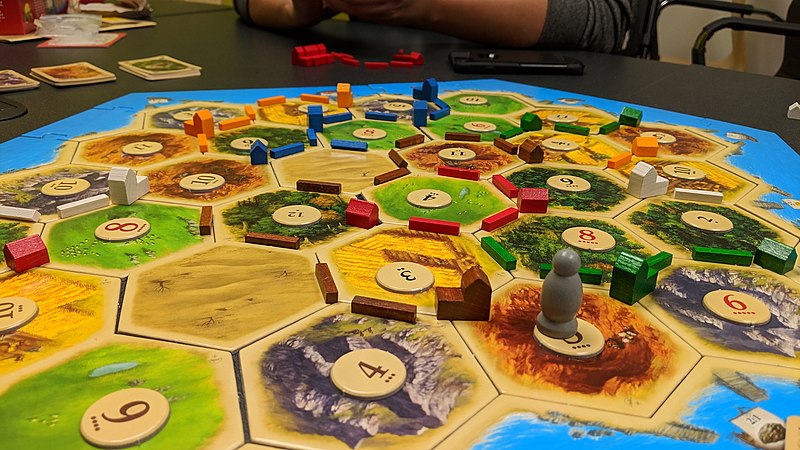 Catan is a game that uses the synthesis of simple rules, chance and strategy to create gameplay emergence with high replayability. The organiation of the playspace and the number tokens on each resource creates a synthesis and interconnectedness of resources and probablistic advantage that immediately invites causative feedback loops between players as the first settlements and roads become placed. Different strategies emerge before single die is rolled as players are already setting themselves up for what they feel will be success or failure as the game plays out. Once gameplay begins with dice rolls (chance), trade (politics), and further actions on objects within the playspace to continue the system of the entire game will move from balanced to reinforced. The ultimate goal of Catan is to be the first to achieve 10 victory points. The interconnectedness between different action strategies on objects within the playspace and rules allows for systems to synthesize toward the ultimate goal of dominance. Building longer roads can lead to gaining the longest road 2-point card as well as enabling the ability to build more settlements and cities and preventing opponents from being able to gain needed resources to build their strategies. Since the design of Catan allows for multiple strategies to play out simultaneously we can see just how simple yet profound the systems are.
Within this beautifully designed game we see simple interconnected systems of trade, building, chance, scarcity, thievery, collection, spending, and more all in play by different people simultaneously.
Mario Kart
If you don't know this game please google it to get the gist. Mario Kart is a racing video game that employs some awesome enhanced systems to create some amazing emergence.
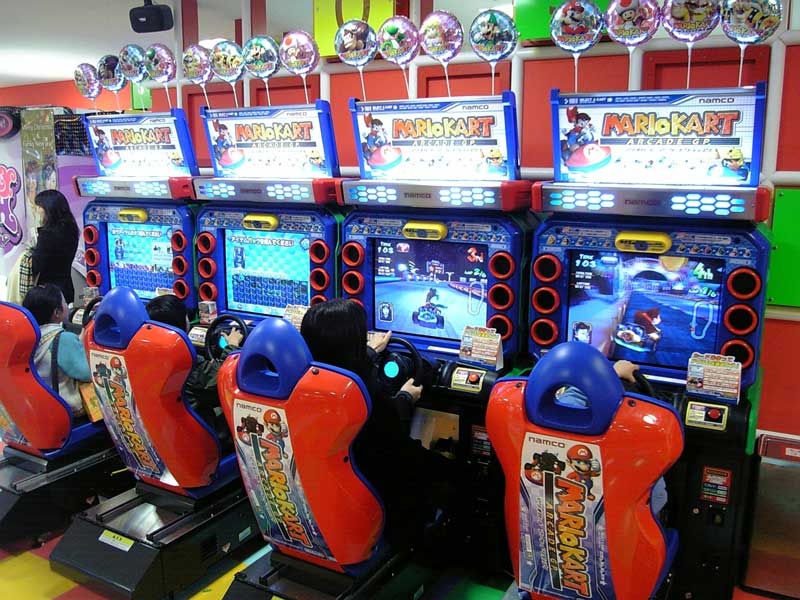 Mario Kart at its core is a racing game. The goals are simple. Be the first player to cross the finish line and you win. The actions at the core are also simple. You can accelerate, break, steer and drift your kart around the racetrack (playspace) in your pursuit of the goal of being first. All racing games have these actions in common to some extent. Where the Systems in Mario Kart emerge is in the option to choose different drivers and karts that enable variance in speed, acceleration, weight, handling and traction. Throughout the track there are item boxes that randomly assign special ability objects that allow you to affect gameplay in varyingly devastating ways. (Purple Turtle Shell Anyone?). Certain kart drivers increase the probability of certain power-up items to be received as well. Also, the playspace allows for players to take different paths as well. The rules for the game are the same for all players, but the causality of actions and effects within any single race takes these systems all built upon common physical system simulations like gravity, inertia, collisions, traction and more to make for truly entertaining and frustrating emergence of competitiveness. Furthermore the same mechanics can be reworked for different system challenges like battle arena play and more. Mario Kart also uses artificial intelligence to make up opponents when other players are not present to play. The systems required to simulate this kind of gameplay is a whole nother level of system thinking thats based on centuries of math and analysis and modeling to enable.
Mario Kart is a racing game that enables the emergence of fun play and entertainment that allows for different strategies and experiences with a healthy dose of randomness to inject variance for a massive amount of replayability. Different systems implemented in different ways to completely change goals yet all built on the same core mechanics. This was my favorite game on the SNES as a kid and remains the same today on Nintendo Switch. That's some long-term system thinking there.
Assignment
As budding game designers it is our responsibility to break games down to their core elements as we explored last week. Those elements are great to get started, but it is in our exploration of big picture and small picture systems thinking that we begin to assemble those elements into interconnected relationships that enable emergence. That is our holy grail. The experience of the players involved.
Taking everything we have explored with systems thinking and systems in general here is your assignment for this week.
1 Journaling: Take some time to think about some of your favorite games you have played. This could be a video game, board game, sports game, party game, etc. As you think about the game and your experiences with it have a pen and paper at hand (or a full on journal) to jot down the things you come up with from your thought process. Think about when you've played that game and why it is your favorite. What are the reasons you like it? How do you feel when you are getting ready to play, while you play, and when you are done playing? How do these feelings affect your interest in replaying the game in the future. What other areas of your life have been affected by the game like art, fashion, music, friends, etc. Chances are this game did a fantastic job creating emergence in you and I want you to explore that emergence from your perspective as broadly and deeply as you can.
2 Elements: Next I want you to list out all of the different elements of the game you can think of that will cover the games possibilities at a high level. I'm not looking for a list of every single object, level or character, but a description of the kinds of objects, actions, playspaces, rules, goals and players there are.
3 Mapping: Next I want you to get a clean sheet of paper and looking at your journaling of your experience with the game and your listing of game elements I want you to look at the relationships between player actions and objects and the playspace to identify webs of relationships within systems and between systems. When you are done you should have something that resembles a mind map diagram where you have bubbles for objects and player actions and the connecting lines represent the relationships between those actions and the causes and effects that result.
4 Synthesis: Finally I want you to take your journaled relfection, your game elements lists and your systems map and assemble them into a single word document that is organized in a way that best communicates this exploration of your favorite game. I am purposely being vague about the specific format of this paper so you can feel free to utilize your own creative approach and skills to best represent and communicate it. The grading criteria will not be based on specific formatting, grammar or other common criteria. What I am looking for is a solid representation of your thoughtful and thorough exploration of the game, its elements, and its systems and how that has led to the emergence as your favorite game.
5
Submission: Once complete please save the Word Document with a file name matching this format. Replace 'Lastname-Firstname' with your actual name.
'Lastname-Firstname'_Assignment2.docx
(Example: Swardson-Brad_Assignment2.docx)
6 Click on Assignment 2 in the UNM Canvas Assignments Listing.
7 Scroll down to Assignment Files and Browse Local file to select the file you created and attach it to your submission for this assignment.
Please make sure you also complete the other requirements in your todo list like discussion post and quiz. Don't forget those.
-
Instruction
Class Lecture, Lab, and Review Module Written & Video Material -
Suggested Reading
AGD: Chapter 1: p. 13-46