Module 15 - Design in Production
Overview
Welcome to the last module!!!
You've made it to the end of our game design class. We have covered an absolute ton of information this semester. So much theory. So, so many bullet points. Yet, so much wisdom and hopefully intrigue as well. Well done for making it all the way. This is going to be a very easy final week for you. A simple posting of your final game design for your classmates to see in discussions, and a final section exam. That's it.
Or is it?
It can seem like once the games design is complete and has moved into production, that the design process stops. Sometimes in very strict development schedules this can be mostly the case. However, most of the time... design just... continues....... just like the new material in this class :)
Now... just because design continues, doesn't mean it is as large of a process or as much of a focus as it is earlier in the process. Remember we are working iteratively. So let's take a quick look at a few things to consider about the kinds of design that can happen inside of the production phase of a game
Design in Production
Once the main iterations of game design are complete. When the design document is fully fleshed out. When many prototypes have been developed and playtested. When playtest evaluations have lead to the team feeling like a solid game concept has been created and understood. This is when the game moves into full and final production. However, the reality is a lot of the work done on prototypes will likely generate real code that will be used within the final game. Other pre-production work has also likely begun as well including art development, modeling, level design, etc. Not everything in production has to wait for all of the design to be completed before final assets begin development. Iterative game design processes allow for that kind of agility in production when the right things are "approved" and ready. This means that design work can still be explored even during final production.
Further more production challenges and constraints due to complexity, budget, and time can yield the requirement for solutions to come in the form of changes that must be made within the games design. Levels can be cut. Characters can be eliminated. Technical interactions can be changes. Gameplay actions and flow can be manipulated. Sometimes these kinds of decisions are made at a production level or within leadership, but most of the time a game designer will be a strong part of this decision-making process. And it can be very painful.
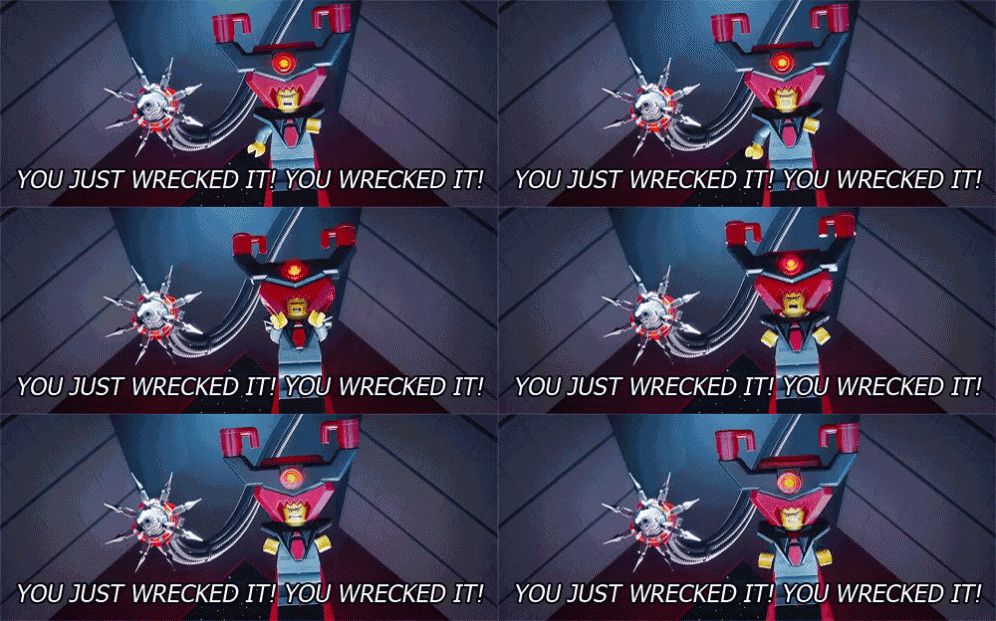 Imagine it. You've spent months or years carefully crafting the games design. Every level is purposefully thought out. Every action brings with it the exact amount of challenge and complexity that the players need to succeed and be excited. Everything is perfect! And then the cold, hard, truth of the nature of limited resources, business challenges, politics, or just plain old "Murphy's Law" shows up and wrecks it all.
In a good production process designers should accept the reality that there is more to the creation of a game than just a perfect and flawless design. Accepting this and becoming a part of the process to solve things is best. However, that doesn't mean roll over and die. That means be a part of how to solve these problems well. Fight for the parts of the design that are essential. The things that playtesting revealed were very important for players and especially those in your target market.
Design doesn't really ever stop up until the final release of the game. The strong hand of the designer does pass the authority more into the (hopefully) capable hands of the development team, but you should fully expect to stay involved throughout production at least to some level to ensure the integrity of the game's design values and player experience are protected.
That's it
See, that wasn't so bad was it?
Thank you for going on this journey with me (Brad Swardson) as we have explored this world of game design together. We have covered concepts around big and small systems thinking, game design tools and kinds of play. We have explored player experiences, iterative process, documentation and level guidance. I hope you have enjoyed your time in this class, but more importantly I hope you have learned meaningful and helpful things that will empower you on your journey in life no matter where you find yourself professionally or in your creative aspects of life.
These concepts, while very...very focused on games, take root and inspiration from much of the world of design. Games are a medium of story telling and human experience that fit within greater contexts and meaning within our life's experiences. You, as a designer, have enormous power at your finger tips to shape culture and the human experience.
This is art what art is. And it has been my pleasure to walk you through this exploration this semester.
Adiós amigos y buena suerte!
-
Instruction
Review Module Written Material -
Assignment
None!